Cables & Tracks
Why Garage Doors Come Off Track, and What Not to Do Next
A door rarely leaves its track in one moment; the geometry drifts for months and one roller finally lets go. Here is what causes it, what each additional cycle costs you in parts, and why a jammed door with wound springs is holding energy.
The short version
- The track guides the door and does not carry its weight, which is why a displacement of a quarter of an inch at one bracket is enough to let a roller out of the channel.
- Six causes cover nearly every off track door: vehicle contact, a broken or jumped cable, worn rollers, loosened track fasteners, an opening racked out of square by foundation movement, and an obstruction under a closing door.
- Each additional opener cycle after a roller leaves the channel adds damage in a predictable order: folded track, hinges tearing out and leaving elongated holes, a creased section, then a twisted shaft.
- Bowed track can be trued and refastened, but kinked track is permanently narrowed at the fold and the roller will catch there on every cycle for the rest of the door's life.
A door that comes off track almost never fails in a single moment. The geometry has usually been drifting for months, one loose lag bolt and one worn roller stem at a time, and the roller that finally left the channel was the last event in a long sequence. Which part of that sequence you are in decides whether this is an hour of alignment work or a job involving new track, hinges and a section.
What follows is the mechanism: the six conditions that put a roller outside the channel, why every press of the button afterward costs you a specific part, and the order the work has to happen in when the springs are still wound.
The three parts of a track, and the load that none of them carry
A sectional door runs on three pieces of formed steel per side. The vertical track is lag bolted to the jamb and holds the door flat against the opening. The radius curve at the top transitions the rollers from vertical into horizontal travel; it is the tightest bend in the system and where the sections pivot hardest, which is why it wears first. The horizontal track runs back under the ceiling.
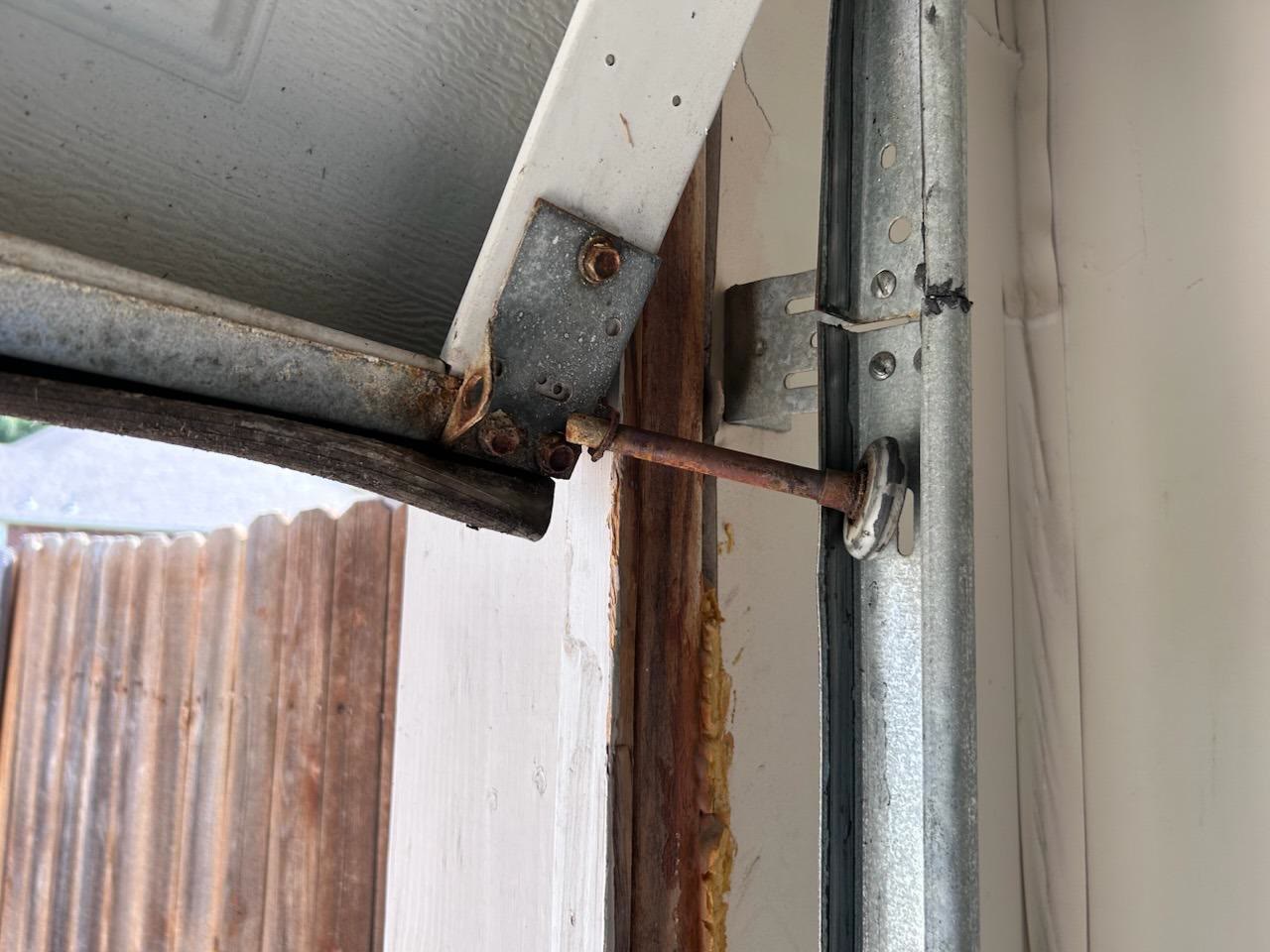
None of the three holds the door up. Springs and lift cables carry the weight, and the track only constrains where the door may go. It is light gauge steel because it was never asked to support two hundred pounds, only to keep a wheel traveling straight, and a guide that light tolerates very little displacement. Move the rail a quarter of an inch outward and the wheel rides the lip of the channel.
The six causes, roughly in the order we find them
There is little mystery in this part of the diagnosis. Six conditions account for nearly every off track door, and the job is not finished until one of them has a name.
- A vehicle bumped the door. The most common trigger, and usually a slow contact rather than a collision: a bumper touching a closed door while parking, or a door caught by a mirror. The section is pushed past the lip of the track and those rollers leave the channel.
- A cable broke or jumped its drum. Each lift cable holds one corner of the door up. Lose one and that corner drops several inches in a second, the door goes diagonal, and the low side rollers are dragged out of the channel while the high side binds.
- The rollers wore out. A steel roller with an open bearing, or a nylon roller a decade into service, develops play at the stem and flat spots on the wheel. A wheel that no longer runs true rides high in the channel, and a loose stem lets the section shift sideways.
- Track fasteners loosened. Every cycle sends vibration through the lag bolts at the jamb and the ceiling hanger brackets. Over years they back off a fraction of a turn at a time, the rail creeps outward, and the gap exceeds the depth of the roller wheel.
- The opening moved. A foundation that has shifted takes the jamb out of plumb, and an opening that is no longer square holds two tracks that are no longer parallel.
- Something was under the door when it closed. One side stops on the object, the opener drives until its force setting trips, and by then the cable on that side has gone slack and those rollers have unloaded.
The cause dictates the repair. Putting rollers back with no explanation for how they left is a delay. If a cable broke, that cable and usually its mate are replaced and the drums reset. If fasteners walked out, the track is refastened into sound wood at a fresh location, because a lag hole chewed oval will not hold torque.
The clay under this side of the metroplex, and what it does to an opening
Much of the eastern half of the metroplex sits on Blackland Prairie soil, an expansive clay that swells through a wet spring and shrinks through a dry August. That movement is not uniform under a slab, so one corner of a garage rises relative to another. Over enough seasons the opening racks out of square, and the two vertical tracks stop being parallel and plumb.
This is why Mesquite, Garland, Forney and Rockwall produce a particular version of this call. The seal touches on the left before the right, and there is a wedge of daylight along the bottom. One side reaches the floor first, the opener keeps driving toward its programmed stop, the cable on that side goes slack for the last inch, and those rollers lose their preload. Do that twice a day for two years on a roller that already has stem play, and one morning it comes out.
The daylight test, and what an uneven gap is telling you
Close the door on a bright day and look along the bottom from inside. An even hairline of light is normal. A wedge that grows toward one side means the last inch of every close cycle is unloading one cable. Correct it early: a limit and drum adjustment is a small job and a folded track is not.
Every cycle after the roller leaves the channel buys you another part
A roller sitting outside its channel changes where the force in the door travels, and the opener has no way of sensing that anything is different. It is a motor with a force threshold, and it pushes until that threshold trips, which on a binding door can take several inches of travel. Whatever yields first absorbs that force.
- The track folds where the wheel bears on it, because the roller is now pressing on the outside of a channel formed to resist pressure from the inside.
- A hinge tears out. Pulled where the hinge cannot follow, the fasteners elongate their holes into ovals. The hinge can be replaced; the elongated hole cannot, and the next hinge loosens faster.
- A section creases. With the door diagonal, one section carries a bending load across its width it was never sized for, and a creased section has permanently lost its stiffness.
- The shaft twists. With one cable loaded and the other slack, the shaft carries unbalanced torque, and a shaft that takes a permanent twist will never let the two drums pay out cable evenly again.
That progression is why the most valuable thing a homeowner can do is take a hand off the button. Two rollers out is a straightforward realignment; the same door after four more cycles can need track, hinges, a section and a shaft, and once three sections are damaged the parts and labor approach the price of a new door.
A bow can be trued, and a kink is finished
What decides whether track is straightened or replaced is the difference between elastic and permanent deformation. Track that is bowed or splayed has flexed: the steel is continuous, the channel keeps its original cross section, and pulling the rail back into alignment and refastening it returns it to service honestly.
Track that is kinked has folded. The steel yielded past its elastic limit and the channel is permanently narrower at the fold. Beat that fold until it looks flat and the narrowing remains, because the metal was stretched on one face and compressed on the other, so the roller will catch there on every cycle for the rest of the door's life. The same logic decides hinges and end stiles, and a bent bottom bracket is never straightened at all, because it anchors the lift cable under full spring force.
The sequence a technician follows, and why the sequence is the safety
A jammed door is not simply a stuck door. It may be holding several hundred pounds worth of stored spring energy against an obstruction, and the order of operations exists so that energy is released deliberately instead of accidentally.
- Secure the door so it cannot fall or run, with clamps in the track below the bottom roller on both sides.
- Disconnect the opener, and unplug it where someone else might press a button out of habit.
- Release spring tension where the door is jammed and the counterbalance is still loaded. This step separates a controlled repair from an injury, and it is done with winding bars on a supported shaft.
- Walk the rollers back into the channel one at a time, starting from the section closest to correct, because each captured roller constrains the next.
- True and refasten the rail: plumb on the verticals, parallel on the horizontals, and any kinked piece replaced rather than persuaded.
- Reset the drums to equal cable tension, rewind the springs to the turns the door needs, and confirm by hand that the door holds position at waist height.
- Reconnect the opener and re establish travel limits and force, because a door that has been off track is not the door the opener was calibrated for.
That last step is the one most often left out, and leaving it out is the reason a door can go out of the channel again a few weeks after it was put back. A close limit still set for a door that used to sit an inch lower drives the door into the floor every cycle and unloads a cable each time, which is the condition that put the roller out to begin with.
A door stuck at an angle is still storing spring energy
If your door is stuck at an angle, do not pull, pry, or lift on the obstruction to free it. The springs are still wound and still trying to lift the door, the obstruction is the only thing holding that energy in place, and the moment it clears the door can move suddenly and with real force in a direction nobody predicted. The same applies to a slack or hanging cable. Leave the door where it is and keep people and vehicles out from under it.
Need this done?
We handle off-track repair across Dallas and the eastern metroplex. Call (469) 891-6883 or book online.
Questions
Common questions
Can I put the door back on the track myself?
If the door is fully closed, the springs are intact, both cables are tight, and a single roller has come out with no other damage, it is sometimes recoverable by hand. If the door is stuck partway, sitting crooked, or has a slack cable, it is not, because the counterbalance is holding energy that will release when the jam clears. If you cannot say for certain whether the springs are still under load, treat the door as loaded.
How can you tell a bent track from a kinked one?
Run a finger along the inside of the channel where the damage is. A bow is a smooth curve with the channel still at full width all the way through. A kink has a hard line where the steel folded, and the channel narrows there. A bow can be trued and refastened; a kinked length of rail gets replaced, because the roller will catch on that fold every cycle.
The door came off track once and I got it back. Why did it happen again?
Almost always because the cause was never identified. The three that repeat are loose track fasteners that keep backing out, a worn roller with stem play, and an opener close limit set too deep so one cable goes slack on every close. Putting the roller back addresses the symptom, and the door finds the same gap again within weeks.
Why do doors on the east side of the metroplex seem to do this more?
Expansive Blackland Prairie clay moves seasonally under slabs, and homes in areas like Mesquite, Garland, Forney and Rockwall see the opening rack slightly out of square over the years. The tracks stop being parallel, the door meets the floor unevenly, and one cable unloads at the end of every close cycle. It is a real mechanism rather than a coincidence.
Is it cheaper to keep repairing an off track door or to replace it?
That depends almost entirely on how many cycles were run after the roller came out. Rollers, hinges and a length of rail are a normal repair. Once three or more sections are creased or the shaft has taken a permanent twist, the accumulated parts and labor start approaching the cost of a new door, and we would rather say that at the start than after two visits.
More advice
Keep reading
Cables, Drums, and Why One Corner of the Door Drops
A garage door hangs from two steel cables, and when one fails that corner has nothing holding it. This covers cable construction, drum grooves and set screws, safe inspection, and the difference between a cable that broke and one that jumped.
SpringsTorsion or Extension: Two Ways to Carry the Same Weight
One system stores the weight of your door as twist on a shaft, the other stores it as stretch along the tracks. Knowing which is over your head changes what you inspect, what can hurt you, and why one door tracks squarer than the other.
SpringsSpring Sizing Is the Whole Job: Wire, Inside Diameter, Length, and Wind
The part of a spring replacement that decides whether the door works for a decade is not the wrench work, it is the four numbers on the spring. This covers wire, inside diameter, length, wind, and how a door actually gets weighed.