Cables & Tracks
Cables, Drums, and Why One Corner of the Door Drops
A garage door hangs from two steel cables, and when one fails that corner has nothing holding it. This covers cable construction, drum grooves and set screws, safe inspection, and the difference between a cable that broke and one that jumped.
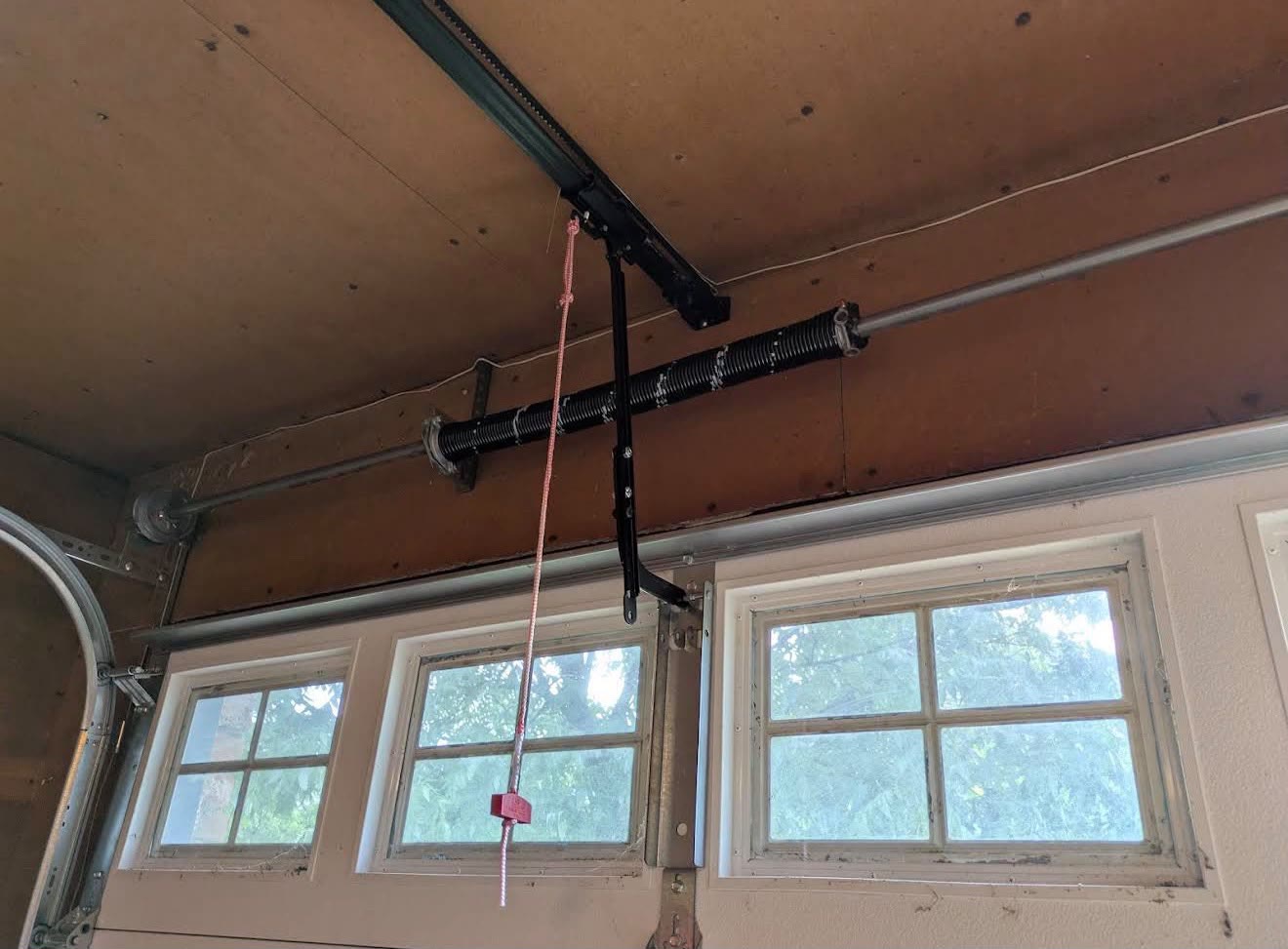
The short version
- Lift cables are wire rope built from strands laid around a core, and they wear only where they bend under load, which means at the drum groove and the bottom bracket fitting rather than along the straight run.
- A drum set screw that creeps loose lets the drum shift on the shaft, so the cable rides onto the flange instead of seating in its groove and saws itself apart there.
- The bottom brackets carry the entire counterbalance load whenever the door is closed, which is why the factory warning label is on them and why they are never loosened while the springs are wound.
- Running the opener once with a broken cable takes the door diagonal in the opening and turns a cable repair into a section, track, and hinge repair.
A garage door hangs from two steel cables, one at each bottom corner, and those cables are the only physical connection between the counterbalance above the opening and the door itself. When one lets go, that corner has nothing holding it, which is why the door goes up or comes down visibly crooked and binds in the tracks.
Almost every cable failure is predictable from a two minute inspection, because cables do not fail randomly along their length. They fail at the two points where the steel is forced to bend under full load, and both can be seen with the door closed and a flashlight.
What aircraft cable is, and why it wears where it bends
A lift cable is galvanized steel wire rope, typically around an eighth of an inch in diameter on a residential door, built by laying fine wires helically into strands and those strands helically around a central core. That construction is what makes it flexible: when the rope bends, the wires and strands slide slightly against each other instead of the outside of the curve having to stretch.
That same sliding is the wear mechanism. Along a straight run the strands do not move relative to one another and the cable is simply in tension, which steel handles superbly. Where it bends around a radius under load, the outer strands travel farther than the inner ones on every cycle and shear against each other. Wires break one at a time and their ends stand proud of the rope, which is the fuzzy section you can see.
The drum groove, the wraps, and the set screws that creep loose
A drum is a grooved cylinder on each end of the torsion shaft. The groove is a helical track sized to the cable, and its job is to make the cable lie down in a single neat layer, one wrap per revolution, without stacking on itself. It must hold enough groove for the full travel of the door plus a reserve, which is why dead wraps are left on it when the door is open.
The drum is clamped to the shaft by set screws bearing on the shaft, ideally on a machined flat. Every cycle sends a torque impulse through that joint, and a set screw tightened but never fully seated walks out of position over months. Once the drum can rotate a few degrees independently of the one at the other end, the cable stops feeding cleanly into its groove, riding onto the flange and sawing against the edge.
A cable that broke and a cable that jumped are different repairs
A broken cable has parted at one of the two bend points and left a loose end. That corner dropped, the door is jammed in the track, and the cable has to be replaced along with whatever the failure damaged. The important part is finding the cause, because a new cable fitted to a scored groove or a loose set screw will fail again.
A jumped cable is a different event with a similar appearance. If a closing door lands on something, a trash can, a bag of soil, or the tailgate of a pickup, the door halts while the drums are still rotating under spring torque. The cable goes slack, lifts out of its groove, and re tensions in the wrong place. Nothing has broken, but the door lifts crooked and can jam hard.
You can tell them apart from a safe distance. With the door closed, a loose end hanging and the door sitting low on that side means the cable broke. Two intact cables with one visibly slack means it jumped. Either way the fix begins by not running the opener again.
The bottom bracket is the most dangerous fastener on the door
Every time the door is closed, both bottom brackets carry the entire counterbalance load, because those brackets are where the cables terminate and where all of the spring force enters the door. The bolts through a bottom bracket are not holding up a panel. They are the last link in a chain that starts at a wound spring several hundred pounds strong.
That is why manufacturers apply a printed warning label directly to that bracket, and the label is accurate. Undo those bolts with the springs still wound and the bracket does not come loose in your hand. It leaves the door with the cable still attached, travelling up the track with all of that stored energy behind it.
Never loosen a bottom bracket while the springs are wound
A wound torsion spring holds its energy continuously, and both bottom brackets carry that load whenever the door is down. Removing or loosening a bottom bracket bolt under those conditions releases the load through the bracket and the cable, at the corner of the door where your hands are. The correct sequence is always the same: unwind the springs with proper winding bars so the cables go completely slack, and only then touch the bracket. The same applies to the cable itself; do not unhook, cut, or re seat a cable on a door whose springs are still wound.
How to inspect your cables safely with a flashlight
This inspection is a looking job. It involves no tools and no contact with any part under load, and it will tell you more about the state of your door than any noise it makes.
- Close the door completely and leave it closed. Do not pull the opener release, and do not touch the springs, drums, cables, or brackets.
- Unplug the opener at the ceiling outlet, so no remote, keypad, or wall button can start the door while your head is beside the track.
- Look at the last several inches of cable at each bottom bracket, where it loops through the fitting, for a fuzzy section, a wire standing out of the lay, a kink, or orange rust bloom where the slab holds water.
- Follow the cable up the vertical track with the light, checking it runs straight and is not rubbing a roller stem or the track edge.
- Check the track for a bright score line or a bowed section, which means a roller or cable has been pulled sideways against it.
- At the top, look at the drum without touching it: the cable should sit in the grooves as a single neat layer, and the two sides should look identical.
A bright polished band is a watch item. A fuzzy section with broken wires standing out of it is a replace item, because once a cable starts losing wires the remaining ones each carry more load and go faster. Rust bloom at the bottom bracket matters particularly near Lake Ray Hubbard and Lewisville Lake, where humid air and a slab that stays damp attack the same square inch of hardware.
Why unequal drums rack the door and mark one track
The two drums have to be wrapped identically and tensioned identically, so that the lower corners of the door rise at a matched rate. If one drum is set differently by even a fraction of a wrap, one corner leads the other on every cycle and the door passes through the opening a little out of square. That is not a dramatic event, which is why it goes unnoticed.
The damage accumulates in identifiable places. Rollers on the lagging side ride hard against one track flange, wear flat on one face, and bend their stems. The track develops a bright polished line down one side, and end hinges elongate their fastener holes. Given long enough the door takes a permanent set out of square that resetting the drums will not undo.
Running the opener once with a broken cable changes what the repair is
A cable repair caught early is contained: two cables, an inspection of the drums and shaft, a rebalance, and a check of whatever the failure touched. What makes it much larger is one more press of the button. With one cable gone, the loaded side keeps lifting while the failed corner stays on the slab, so the door goes diagonal within a foot of travel.
From there the damage is mechanical and fast. Rollers pop out of the track on the low side, the track bends where a roller levers against it, the bottom section takes a bending load across its width and creases, and hinges tear at their fasteners. A cable job becomes a cable, section, track, and hinge job, and once three sections are damaged you are paying nearly what a whole new door would have run.
Unplug it rather than just avoiding the button
The wall control is not the only way that door gets run. A remote in a visitor's car, a keypad on the outside jamb, a phone app, or somebody in the house who has not heard about the problem will all start the opener. Pull the plug at the ceiling outlet, and if the door is stuck partway, tape a note over the wall control.
What else gets inspected while the system is apart
Cable work is one of the few times the whole load path is accessible, so it is when the parts nobody can normally reach get looked at. The end bearing plates and the center bearing are only reachable with the springs unwound, and a bearing that rumbles or has play lets the shaft move and puts the cable back out of its groove within a year. Drum grooves get checked for scoring.
The rest is the hardware the failure touched: bottom bracket rollers bent from the door dropping on one side, roller stems bowed on the lagging side of a racked door, the track flange where a bright gouge shows what happened, and the hinges nearest the failure. The springs are looked at too, because their cycle life is a number you are entitled to have before deciding whether to do this work once or twice.
Need this done?
We handle broken cable repair across Dallas and the eastern metroplex. Call (469) 891-6883 or book online.
Questions
Common questions
Why did my garage door cable snap on one side only?
Cables wear where they bend under load, which means at the drum groove at the top and at the bottom bracket fitting at the bottom. Whichever side has a slightly loose drum set screw, a scored groove, or standing water against the bottom corner wears faster, so one side reaches the end first. The other is usually not far behind, which is why both cables are replaced together.
Can I still use my garage door with one broken cable?
No, and running it once is what turns a small repair into a large one. With one cable gone the loaded side keeps lifting while the failed corner stays down, so the door goes diagonal within a foot of travel, rollers leave the track, and the bottom section can crease. Unplug the opener at the ceiling outlet and leave the door where it is.
What is the difference between a cable that broke and one that came off the drum?
A broken cable has parted and left a loose end hanging. A jumped cable is intact but has come out of its groove, usually after the door landed on an obstruction and the drums kept turning while the cable went slack. Both make the door lift crooked, but the second is repaired by unwinding the springs, re seating the cable, and resetting the drum rather than by replacing it.
How often should I check my garage door cables?
Twice a year is reasonable, and it takes about two minutes per side. With the door closed and the opener unplugged, use a flashlight to look at the last few inches of cable at each bottom bracket and at the wraps on each drum, checking for fuzzy sections, a wire standing out of the lay, kinks, or rust bloom. Compare the two sides, because a difference between them is the finding.
Why does my door lift crooked even though both cables look fine?
Most often because the two drums are not set to the same number of wraps or the same tension, so one corner leads the other on every cycle. A drum set screw that has crept loose on the shaft does the same thing. It is worth correcting early, because a door that travels out of square long enough eventually takes a permanent set that resetting the drums will not undo.
Why does rust show up at the bottom bracket first?
That corner sits against the slab, which stays damp along the bottom seal after rain and holds water at the joint. In garages near Lake Ray Hubbard and Lewisville Lake, humid air and condensation on cold steel add to it, so the bracket, the fasteners, and the last few inches of cable corrode while the rest of the run still looks new.
More advice
Keep reading
Why Garage Doors Come Off Track, and What Not to Do Next
A door rarely leaves its track in one moment; the geometry drifts for months and one roller finally lets go. Here is what causes it, what each additional cycle costs you in parts, and why a jammed door with wound springs is holding energy.
SpringsSpring Sizing Is the Whole Job: Wire, Inside Diameter, Length, and Wind
The part of a spring replacement that decides whether the door works for a decade is not the wrench work, it is the four numbers on the spring. This covers wire, inside diameter, length, wind, and how a door actually gets weighed.
SafetyPhoto Eyes: Why the Door Reverses Before It Reaches the Floor
A door that starts down, touches nothing, and runs back up is almost always reporting a photo eye problem, and most of those take ten minutes and no parts. Here is how to read the LEDs, fix the ordinary causes, and recognize the faults that are not the eyes.