Springs
Torsion or Extension: Two Ways to Carry the Same Weight
One system stores the weight of your door as twist on a shaft, the other stores it as stretch along the tracks. Knowing which is over your head changes what you inspect, what can hurt you, and why one door tracks squarer than the other.
The short version
- Torsion springs store energy as twist on a shaft above the opening while extension springs store it as stretch along the horizontal tracks, and you can tell which you have in ten seconds by looking at the header from inside the garage.
- The containment cable through an extension spring carries no load in normal use and exists solely to capture both halves if the spring fails at full stretch, which is why we recommend it on any extension door lacking one.
- A torsion door travels squarer because both cables are driven off one shaft, while an extension door is two independent systems whose springs and pulleys wear at different rates and slowly drift apart.
- Standard torsion hardware needs roughly twelve inches of headroom above the door, which is the usual reason older shallow header garages in Richardson and Garland still run extension springs.
Every sectional garage door is a counterbalance machine, which means something in that garage holds the weight of the door while it is down and gives it back while it goes up. There have only ever been two ways to do this on a residential door: store the energy as twist, in a spring wound around a shaft above the opening, or as stretch, in a spring pulled out along each horizontal track.
Which system sits over your head was not a preference and usually not a brand decision. It was settled by the weight of the door, the headroom above the opening, and the decade the house was framed. Knowing which one you have changes what you should look at during a walk around, and it changes which parts on your door are capable of injuring someone standing in the bay.
Twist and stretch: the same job through two geometries
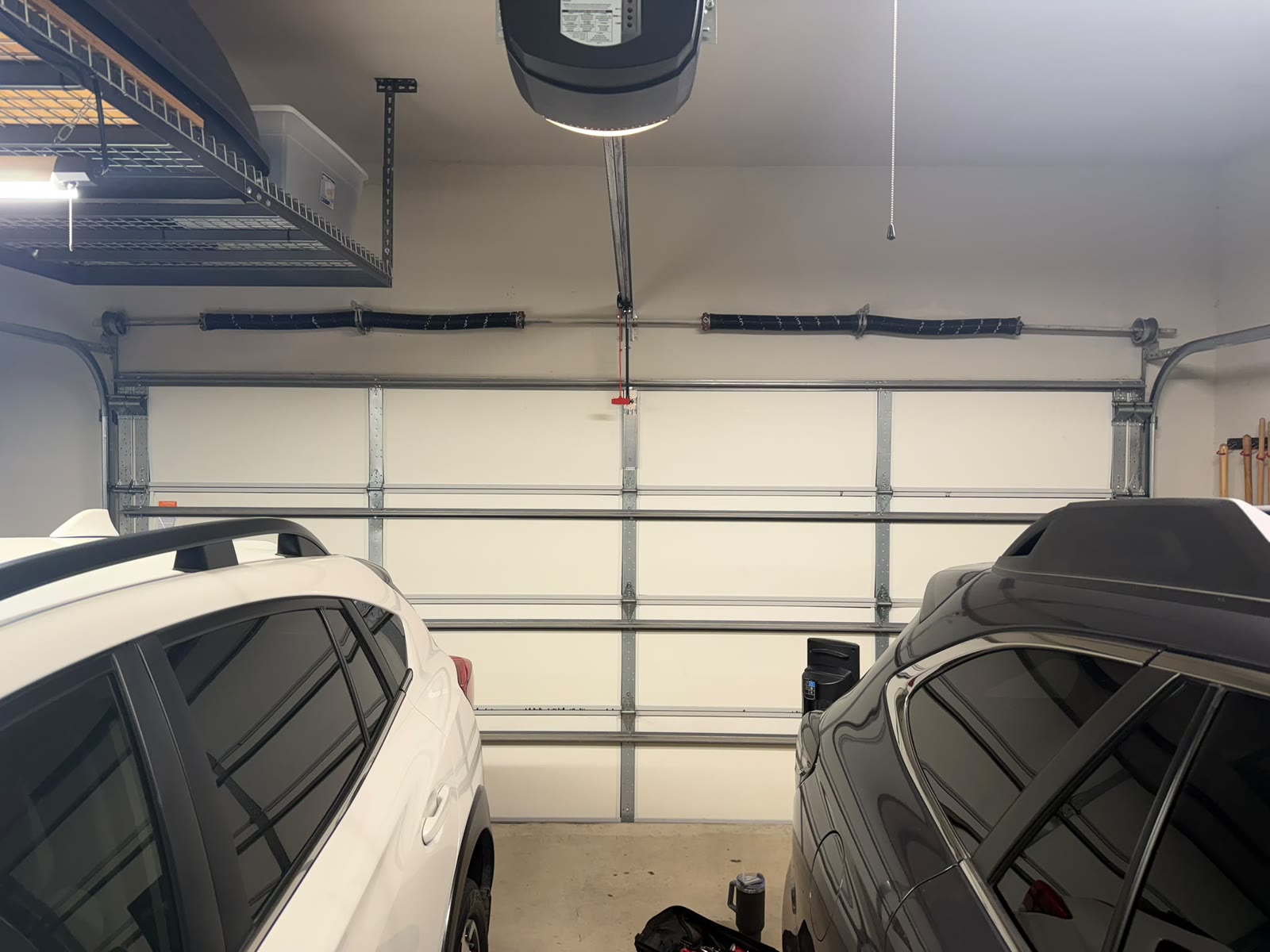
A torsion system puts one or two springs on a steel shaft mounted to the header above the door. At installation it is twisted through a set count of turns, seven and a half being usual on a seven foot door, which loads the wire and stores the energy as torque at the shaft. Grooved drums at each end convert that torque into cable pull, and the cables run down the vertical tracks to the bottom brackets.
An extension system has no shaft at all. A long spring lies alongside each horizontal track near the ceiling, anchored at the rear to a track hanger and connected at the front through a pulley arrangement. As the door comes down the springs are pulled out, storing energy as tension rather than twist. Crucially, the left side and the right side are two separate machines bolted to the same door.
Telling them apart in ten seconds
There is no ambiguous third case on a residential sectional door, and no door has both systems. It is worth doing this once and remembering the answer, because every other diagnostic conversation about your door starts from it.
- Stand inside the garage with the door closed and look at the wall directly above the opening.
- A steel shaft running horizontally across the header, with one or two springs threaded onto it and a drum at each end, means torsion springs.
- A bare header, with a long spring lying parallel to each horizontal track near the ceiling, means extension springs.
- Confirm with the cable path: a torsion cable runs from the bottom corner straight up the vertical track to a drum, while an extension cable turns forward over a pulley toward the spring.
Why extension springs are still common on older single car doors
Extension hardware survives in exactly the neighborhoods you would predict. Richardson is a mid century ranch city west of Central Expressway, Garland is full of post war and 1960s subdivisions, and The Colony has a base of starter homes with narrow eight and nine foot single doors. Those original doors were light, and a light door needs less stored energy. Extension springs were cheaper, quicker to hang, and tolerant of shallow pitch headers.
What changed was the door, not the spring. Double wide openings became standard, insulated sectionals arrived, and glazing and heavier skins added weight an extension pair struggles to hold with margin. An original extension system under an original light door is not automatically wrong; an extension system under a heavier door that replaced the original is a different conversation.
The containment cable through the center of the spring
Threaded through the hollow center of a correctly equipped extension spring is a length of cable, anchored at the rear hanger and at the front bracket. It does nothing during normal operation. It carries no load, adds no torque, and has no effect on balance. It exists entirely for the failure event, and it is the single most important part on an extension door.
An extension spring is at full stretch and holding maximum energy when the door is closed, which is also when the family is standing beside it getting into a car. When such a spring fails it does not sag or drop. Both halves snap back toward their anchors at speed, and the free end whips laterally across whatever is in front of it, which in most garages is the roof of a vehicle.
An extension spring without a containment cable is the most dangerous part in a residential garage
Look up along both horizontal tracks. If you cannot see a cable running through the middle of each extension spring, anchored at both ends, that door has an uncontained energy store above the parking bay. The part is inexpensive, and we recommend it whether or not the spring is near failing. Do not attempt to unhook, stretch, or replace an extension spring or its S hook yourself: it is fully loaded whenever the door is down, and the safe working state involves the door raised and physically secured in the tracks so it cannot descend.
Pulleys, sheaves, and the S hook are where an extension system wears
An extension system has far more hardware in the load path than a torsion system, and each item is a wear point. At the front of each horizontal track there is a stationary pulley on a bracket, and in the loop at the front of the spring a floating sheave that travels as the door moves. Each turns on a bushing that arrives with a little grease and never receives more, and summer heat drives out what there is.
The S hook at the rear, a piece of bent steel joining the spring to the track hanger, is the other classic failure: thousands of tension cycles open it slightly and wear it thin until it releases. The symptoms are recognizable. A squeal at the same point of travel every time is a seized pulley being dragged rather than rolled. A cable fraying where it passes over one sheave is that sheave no longer turning.
Why a torsion door travels squarer and an extension door drifts apart
On a torsion door both drums are locked to a single shaft, so the left cable and the right cable are taken up at exactly the same rate by mechanical necessity rather than by adjustment. If the left corner has risen four inches, the right corner has risen four inches, and the only way for that to stop being true is for a drum set screw to slip.
An extension door has no such link. Each side has its own tension, its own adjustment clip, its own pulleys, and its own rate of fatigue. The two are matched on installation day and begin diverging immediately, because no two springs relax at the same rate. Over years one corner leads the other by a fraction of an inch and the rollers on the lagging side ride hard against one track flange.
A one person test that shows you the drift
Close the door, disconnect the opener at the red release handle, then raise the door slowly by hand and watch the gap along the top edge of the door against the header as it rises. On a healthy door that gap stays even. If one corner visibly leads the other, the two sides of your counterbalance are no longer matched, which on an extension door means springs and pulleys and on a torsion door means a drum has slipped.
Headroom is often what makes the decision for you
Standard torsion hardware needs room above the opening for the shaft, the springs, the center bearing bracket, and an end bearing plate on each side, which in practice means about twelve inches of clear space above the door before the ceiling or the joists get in the way. Extension hardware runs alongside the horizontal tracks and needs very little above the header. In shallow pitch 1960s garages in Richardson and Garland, that twelve inches is not there.
Low headroom torsion conversions exist, using a double track arrangement or brackets that mount the shaft behind the door rather than above it, and a jackshaft opener on the wall beside the door removes the ceiling rail entirely, which is why they appear on the alley loaded garages in newer parts of Frisco. Side room matters too: standard vertical track hardware wants roughly three and three quarter inches of clear wall on each side.
One torsion spring or two, and what converting actually involves
The number of torsion springs is a torque question, not a safety rating. The door needs a specific torque at the shaft, and a single spring can supply it if the required wire size and length fit the available shaft space. On a double wide door, especially an insulated one, the torque needed is often more than one spring of practical size can deliver, so two are used, each working at lower stress.
Converting an extension door to torsion is a hardware change, not an adjustment. It means weighing the door, lagging an end bearing plate into the header on each side, mounting a center bearing bracket, fitting a shaft with correctly sized drums, running new lift cables, and stripping out the extension springs, pulleys, containment cables, and rear hangers. It is worth doing when the extension hardware is worn but the door is sound, or when a heavier door has been hung on hardware sized for the light one it replaced. It is not worth doing on a light single door whose hardware is all in good condition, and we say so when that is the case.
Need this done?
We handle broken spring repair across Dallas and the eastern metroplex. Call (469) 891-6883 or book online.
Questions
Common questions
How do I tell if I have torsion or extension springs?
Close the door, stand inside, and look at the wall above the opening. A horizontal steel shaft with springs on it and a drum at each end means torsion. Long springs lying parallel to the horizontal tracks near the ceiling, with nothing above the header, means extension. No residential door has both systems.
Are extension springs unsafe?
They are safe when correctly equipped and dangerous when they are not. The deciding factor is the containment cable running through the center of each spring and anchored at both ends, which captures both halves if the spring fails at full stretch. Without it, a failing extension spring becomes a length of steel travelling across the parking bay at speed.
Is torsion better than extension?
Torsion tracks squarer, because both drums are locked to one shaft and the two corners of the door physically cannot rise at different rates. An extension door is two independent systems that drift apart as springs and pulleys wear at different rates, which is why binding and one sided track wear are common on older ones. Extension still has a place where headroom will not allow a shaft above the opening.
Why does my door have two torsion springs instead of one?
Because the torque the door requires is more than a single spring of practical wire size and length can produce within the available shaft space, which is typical for a double wide or insulated door. Two springs each carry half the load at lower stress, which also helps cycle life. It is not a redundancy feature and it does not make a broken spring safe to work around.
Should I convert my extension door to torsion?
It is worth it when the extension hardware is worn out but the door is sound, when a heavier door has been hung on hardware sized for a lighter one, or when the door is being replaced and the conversion can ride along. It is not worth it on a light single door with good pulleys, sound springs, and containment cables already fitted. The conversion needs about twelve inches of headroom, so that gets measured first.
What is the S hook on my extension spring and why does it matter?
It is the bent steel hook connecting the rear of the spring to the track hanger, and it is the smallest part in the load path. Thousands of tension cycles gradually open it and wear it thin at the contact point until it releases or breaks, which drops that spring and leaves the door lifting crooked. It is one of the first things to look at on an older extension system.
More advice
Keep reading
Why Garage Door Springs Break, and What the Cycle Rating Actually Means
A garage door spring is spent in cycles, not years, and the arithmetic for your own household takes about a minute. This is how fatigue breaks spring steel, why the break happens with the door closed, and what a high cycle rating actually buys.
SpringsSpring Sizing Is the Whole Job: Wire, Inside Diameter, Length, and Wind
The part of a spring replacement that decides whether the door works for a decade is not the wrench work, it is the four numbers on the spring. This covers wire, inside diameter, length, wind, and how a door actually gets weighed.
OpenersChain, Belt, Screw, and Jackshaft: Four Ways to Move the Same Door
Four drive mechanisms are sold to accomplish one small job, and the differences between them have almost nothing to do with strength. Here is what actually separates them in a North Texas garage.