Maintenance
Why a Quiet Door Gets Loud, and What Each Noise Is Telling You
The character of the sound and where it happens in travel narrow a loud door down to one or two parts. Here is the map, the fixes ranked by how much quiet they buy, and the one noise that means stop using the door.
The short version
- The character of the noise plus where it occurs in travel identifies the part: a squeal at a fixed height is a dry hinge or a flat spotted roller, continuous grinding is a dry bearing or grease in the track, and rattle through the ceiling is a structural coupling problem.
- Sealed nylon rollers are the single change that most often takes a door from loud to quiet, because they remove both the steel on steel ring and the dust that destroys open bearings.
- Lubricant belongs on hinge pivots, roller stems, bearings and spring coils, never inside the track, and Texas garage heat argues for a grease with body rather than a thin penetrating spray.
- A door that suddenly becomes loud with a single bang is reporting a failure rather than asking for grease, and the correct response is to stop running it.
Doors rarely get loud all at once. A door gets slightly louder every month for two years, the household adjusts a decibel at a time, and then somebody starts sleeping in the room above the garage and the noise becomes a problem overnight. The useful thing is that door noise is diagnostic: the character of the sound, plus where in travel it happens, narrows the cause to one or two parts.
One exception belongs at the top, because it changes the whole reading. A door that was normal yesterday and made a single loud bang today has not developed a lubrication problem overnight. Sudden, loud and new is a symptom of failure. Gradual and slowly worsening is maintenance.
Reading a noise: its character, and where in travel it happens
Two observations do most of the diagnostic work. First, the character of the sound: squeal, grind, bang, rattle, slap, click. Second, position, meaning whether it repeats at the same height every cycle, happens only at the start of travel, or runs continuously. Stand in the garage with the door running and note both.
A rhythmic squeal at a fixed point in travel
A squeal at the same height every cycle is one component passing through one position, nearly always a dry hinge pivot or a flat spotted roller. A hinge pivot is a steel pin in a steel sleeve, and with the lubricant gone it stick slips as the sections articulate through the radius curve. A flat spotted roller squeals once per revolution; find it by disconnecting the opener and running the door slowly by hand, watching for the wheel that skids instead of turning.
A continuous grinding scrape
Grinding that runs the length of travel is metal on metal, or grit inside a bearing. Steel rollers with exposed bearings are the usual source: the race collects dust, loses its grease, and the wheel skids in the channel instead of rolling. The other source is grease in the track, which collects the fine dust blowing through an unsealed garage and becomes an abrasive paste.
A deep bang or pop at the start of travel
A single deep report as the door begins to move, usually in one direction only, has two common causes. The first is coil on coil friction in a dry torsion spring: the coils are bound against each other and release in one movement as the shaft turns. The second is a section flexing, because a wide door without a strut across the top section bows as the opener arm pulls at its center.
A rattling chatter that arrives through the ceiling
If the loudest place to hear the door is the room above the garage, the transmission path is structural. Three things put door noise into framing: chain slack, which lets the chain slap the rail on every direction change; loose rail brackets and ceiling hangers, which let the assembly move against the joists; and a motor head lag bolted straight into a joist.
A slap when the door seats on the floor
A door that lands with a slap rather than settling usually has a close limit set too far. The opener is driving past the point where the bottom seal meets the slab, and the noise is the door striking the floor. That setting also sends one cable slack on every close, and slack cables are an ordinary route to a door leaving its track.
A click or a clack from the shaft above the door
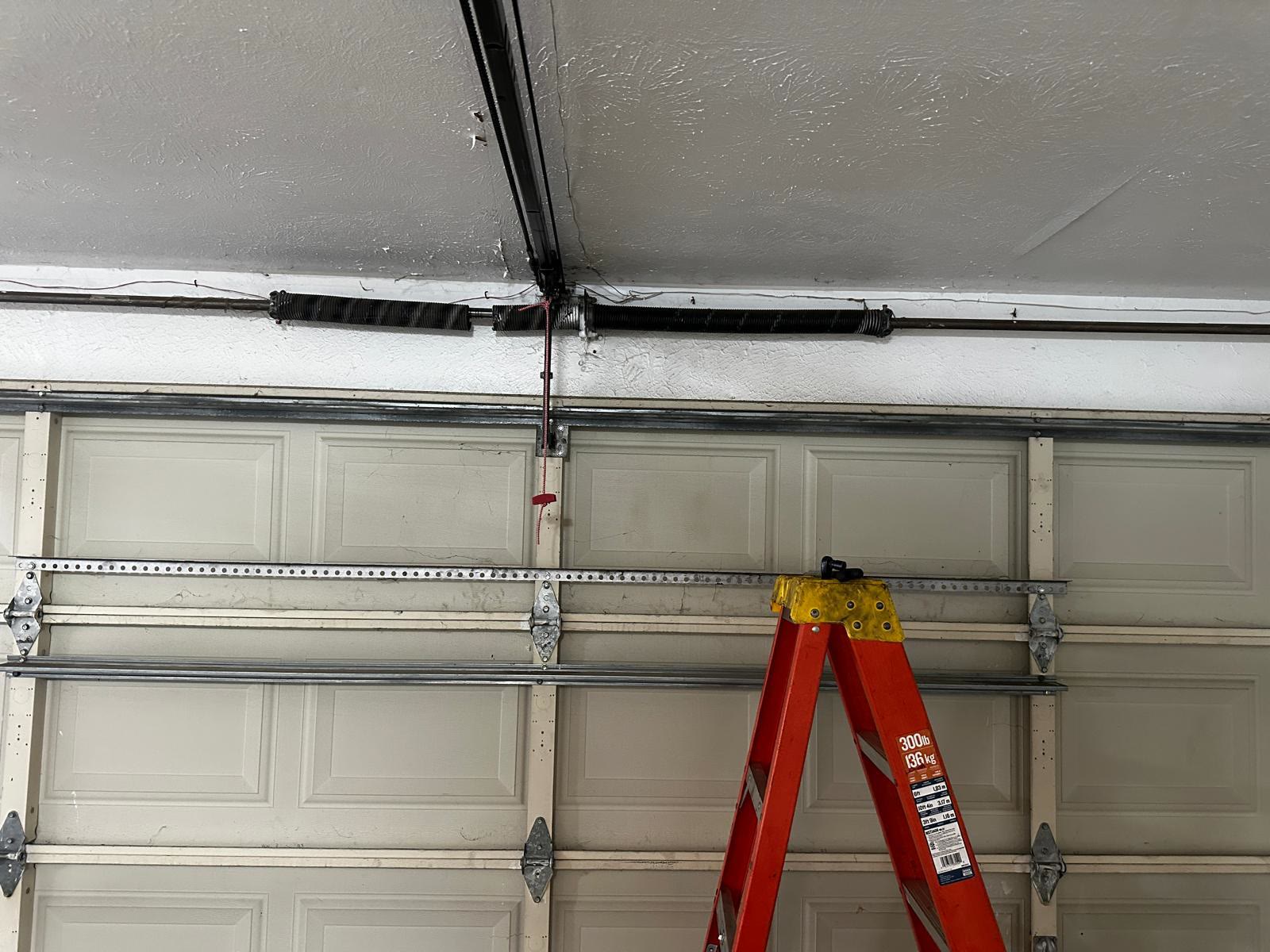
A metallic click near the center bracket or the ends of the torsion shaft points at two parts. A drum set screw that has backed off lets the drum slip a few degrees when the load reverses, clicking at the top and bottom of travel and nowhere between. An end bearing plate that has run dry chirps as the shaft turns inside it. A slipping drum changes cable tension and a seizing bearing scores the shaft.
Rollers are the single largest improvement available
Sealed nylon rollers with ball bearings are the change that most often takes a door from loud to quiet, because they remove two noise sources at once. The nylon wheel does not ring against a steel channel, and the sealed bearing keeps dust out of the race, which is the failure that makes steel rollers grind.
The other half of the value is service life, since the grease in an open bearing running in blowing dust and heat is gone long before the wheel wears out. One caution about doing this yourself: intermediate rollers come out with the door down and the sections supported, but the bottom roller lives in the bottom bracket, which anchors the lift cable under full spring force.
The right lubricant, and the one place it never goes
Use a white lithium grease, or a silicone or synthetic product sold for garage doors. Do not use a penetrating spray as a lubricant. A penetrant is engineered to creep into a rusted joint and free it, so it is thin on purpose; it flashes off and leaves a residue that collects dust.
- Hinge pivots, at the pin where two sections articulate.
- Roller stems, where the stem enters the sleeve, on any unsealed roller.
- The end bearing plates at both ends of the torsion shaft, and the center bearing.
- The torsion spring coils, a light film along the length, which stops coil on coil squeal.
- The opener rail on a chain or screw drive per the manufacturer, and nothing on a belt.
- The lock bar and side locks, so they do not seize and get forced later.
The place that gets nothing is the inside of the track. The channel is a running surface for a wheel that is supposed to roll, and grease there makes the wheel slide, producing exactly the flat spot that causes the squeal you were trying to cure. Wipe the channel with a dry rag instead.
Texas summer is a specific argument for grease over anything thin. An uninsulated garage with a west facing door runs well above outdoor temperature through an August afternoon, and the space above the door where the springs and bearings live is hotter still. A light oil there thins, migrates out of the bearing, and is gone within a season. A grease stays where it was placed and holds a film on the coils.
A cadence you will actually keep
Twice a year suits a household that uses the garage as its main entrance, and the job takes about fifteen minutes with the door closed and the opener unplugged. Wipe the old residue off first, because fresh grease laid over accumulated dust just builds a thicker abrasive.
Getting the opener out of the framing
When the complaint is noise in the bedroom rather than in the garage, the fix is isolation rather than lubrication. The motor head hangs on steel straps, and if those straps are lagged directly into a joist with metal against wood, every vibration the motor makes couples straight into the structure.
Rubber isolator pads between the strap and the joist, or purpose made anti vibration mounts, interrupt that path, and the same applies to the rail bracket at the header. While you are up there, take chain slack down to the manufacturer's specification and snug the hangers so the rail cannot move against its own fasteners.
Tighten to snug, and then stop turning
Hinge and track fasteners loosen from cyclic vibration, and a loose hinge rattles while it lets the section shift sideways. Going around the door with a socket and snugging them is legitimate homeowner maintenance and it quiets a surprising number of doors.
The limit is that these are self tapping fasteners in thin steel, and the threads are shallow. Snug means the fastener stops turning easily and the plate lies flat. Past that you strip the hole, which then has to be relocated into fresh metal. Use a hand ratchet, and leave the bottom bracket alone, because those fasteners hold the cable anchor under full spring load.
Belt drive is a last step, not a first one
A belt drive opener is genuinely quieter than a chain drive, and if you are already replacing an opener on a garage with living space above it, a belt is the obvious choice. It is a poor first move on a door that has become loud, because it changes the drive and nothing else. A worn roller still grinds and a dry hinge still squeals.
The order that buys the most quiet for the least money runs: lubricate correctly, snug the fasteners, replace the rollers with sealed nylon, isolate the motor head and take up chain slack, correct the travel limits so the door stops seating hard, and only then consider changing the drive type.
The sounds that are diagnoses rather than maintenance items
Some noises report a failure that has already happened, and the correct response is to stop using the door rather than to service it.
A single very loud bang, like a length of pipe dropped on concrete, usually with the door sitting still afterward, is a torsion spring breaking. A grinding whir with the door not moving is a stripped drive gear. A repeated snap or ping during travel is strands breaking inside a lift cable. None improve with lubricant, and each means the door is no longer counterbalanced as designed.
Know the sound of a spring letting go
A torsion spring that breaks makes one sharp, extremely loud report that does not resemble any routine door noise. Afterward the door will be far heavier than normal, and you may see a visible gap of an inch or two in the coil on the shaft above the door. Do not run the opener to test it and do not lift the door by hand to see how bad it is. The counterbalance that made a two hundred pound door feel like ten pounds is gone, and that weight now hangs on the remaining hardware.
Need this done?
We handle garage door maintenance across Dallas and the eastern metroplex. Call (469) 891-6883 or book online.
Questions
Common questions
What lubricant should I use, and how often?
A white lithium grease or a silicone or synthetic product made for garage doors, applied twice a year on a door used several times a day. Put it on hinge pivots, roller stems, the end and center bearings, and along the spring coils. Never put it inside the track, because grease there makes the roller slide rather than roll and it collects dust into an abrasive paste.
Why did my door get louder right after I sprayed it?
Almost always because the product was a penetrating spray rather than a lubricant, or because it went into the track. Penetrants are thin by design and evaporate, leaving a dust attracting residue in a joint that is now effectively dry. Wipe the tracks clean with a rag and reapply a proper grease to the pivots and bearings only.
Will a belt drive opener fix a noisy door?
It removes chain noise and nothing else. If the noise is a worn roller, a dry hinge, a flexing section, or a motor head bolted hard to the joists, a belt drive changes none of that. Do the rollers, the lubrication, the fasteners and the isolation pads first; if the door is still noisy after that and you also need an opener, then a belt is worth it.
My door bangs once when it starts to open. Is that dangerous?
Usually it is coil on coil friction in a dry torsion spring releasing at once, or a wide top section flexing because it has no strut. Neither is an emergency, and both are worth correcting, because the first means the spring is running dry and the second means the top section is taking a bending load it was not sized for. A single bang followed by a door that will not lift is a different matter entirely.
Does Texas heat really matter for lubrication?
Yes, and it is one reason doors here go dry faster than the interval most manuals assume. An uninsulated garage with a west facing door gets very hot through the afternoon, and the area above the door where the bearings and springs sit is hotter than the floor. Thin oils migrate out of a bearing under heat and vibration within a season, which is why a grease with body is the better choice here.
Can I tighten the hinge screws myself?
Yes, and it is worthwhile maintenance. Use a hand ratchet, tighten only until the fastener stops turning easily and the plate lies flat, and stop there, because these are self tapping screws in thin steel and stripping a hole creates a larger problem. Do not touch anything on the bottom bracket, which is under full spring load whenever the door is down.
More advice
Keep reading
The Garage Door Maintenance You Can Safely Do Yourself
Several of the things homeowners get charged for take about ten minutes with a rag and one can of grease. Here is the honest line between maintenance you should do yourself and work that genuinely requires tools and training.
Cables & TracksWhy Garage Doors Come Off Track, and What Not to Do Next
A door rarely leaves its track in one moment; the geometry drifts for months and one roller finally lets go. Here is what causes it, what each additional cycle costs you in parts, and why a jammed door with wound springs is holding energy.
CommercialCommercial Door Types: Sectional, Rolling Steel, Grille, and High Speed
Commercial door types are not styles, they are different machines: a sectional runs on track, a rolling steel curtain coils on a barrel, a high speed fabric door is bought for its travel speed. This walks each mechanism, what it needs above and beside the opening, and which building types on the Dallas side of the metroplex each one fits.