Safety
The Door Will Not Close: A Diagnostic Walkthrough
A door that will not close is about eight different problems sharing one symptom, and they separate cleanly by behavior. Follow the branches, fix what is yours to fix, and know the conditions that end the troubleshooting.
The short version
- The behavior of the door separates the causes: no movement and no light is a power problem, a motor that runs with no movement is a drive or trolley problem, and an immediate reversal on closing is almost always the photo eyes.
- A door that reverses near the floor is usually a close limit set too deep, a force setting fighting a real binding roller, or a hardened seal on a slab that has shifted, and the hand balance test separates those in about a minute.
- Photo eye cleaning and alignment, remote batteries, learn button reprogramming and clearing the wall control lock button are all genuine homeowner fixes that need no contact with anything under load.
- A crooked door, a slack or hanging cable, or a visible gap in a spring ends the troubleshooting: unplug the opener and stop moving the door.
A door that will not close is not one problem. It is about eight problems that share a symptom, and they separate cleanly by what the door does when you press the button. Watch the behavior, follow the right branch, and you will either solve it in ten minutes or know exactly what to tell whoever comes out.
Work through this in order. Each branch says whether it is a homeowner fix, and where it is, it gives the steps. A few conditions end the troubleshooting entirely.
Branch one: nothing happens and the opener light does not come on
This is a power branch rather than a door branch, and it is worth clearing first because it is quick and common.
- Look at the motor head. No light and no click when the wall button is pressed means the unit is not getting power rather than that it is broken.
- Find the GFCI. Garage ceiling outlets are frequently on a ground fault circuit whose reset button lives on another receptacle, sometimes in a bathroom.
- Check the breaker panel. A tripped breaker does not always look tripped, so move the handle fully to off and back to on.
- Confirm the outlet with a lamp or a phone charger. If it is dead, the problem is electrical and the door is fine.
- If the outlet is live and the opener is dead, the failure is inside the unit, most often the logic board.
One nuance on newer units: many include a battery backup, and a backup battery at the end of its life can produce an opener that chirps, shows a fault light, and refuses to run even on mains power. Heat shortens those batteries in a garage that runs hot all summer.
Branch two: the opener runs and the door does not move
If the motor is clearly working and nothing happens at the door, the coupling between motor and door has failed or the door is disconnected from it.
- Look at the trolley on the rail. If the emergency release was pulled, the trolley is disconnected and the motor drives the carriage along the rail while the door stays put. Reconnecting usually means pulling the handle back toward the door, or running the opener until the carriage relatches.
- Listen to the motor head. Grinding with the motor spinning and nothing else moving usually means a stripped drive gear. On most chain drive units that gear is nylon and is a replaceable part.
- Watch the chain or belt. If the chain moves and the door does not, the trolley has failed or the connection to the door arm has come apart.
- Disconnect and lift by hand with the door closed. If the door is extremely heavy, the counterbalance is the problem, and that branch ends at the warning below.
Branch three: the door starts down and immediately reverses
A door that begins to close and reverses within the first foot, usually with the opener light flashing, is almost always the photo eye system. Two sensors sit on the vertical tracks within six inches of the floor, one sending an infrared beam across the opening and one receiving it, and the opener will not close unless the receiver sees the sender.
The five second version of this diagnosis is to watch the opener light when you press close. Essentially every modern opener reports a blocked or misaligned beam by blinking in a repeating pattern when a close command is refused. A light that blinks on a close attempt but stays steady when the door opens points at the safety circuit rather than the motor.
- Look along the floor first. A recycling bin, a broom leaning across the opening, or a pet bed costs nothing to move.
- Clean both lenses with a dry soft cloth. Dust and spider webbing are the most common causes, and a garage that takes blowing dust needs this often.
- Read the indicator lights. Typically one sensor is lit when powered and the other when aligned, and a flickering light means the beam is not landing.
- Realign. Loosen the wing nut on the bracket, move the sensor until the alignment light is steady, then tighten without letting it shift.
- Consider the sun. Low morning or afternoon sun on the receiver lens can wash out the beam for a few weeks each year as the sun angle changes.
- Check the wiring. A staple through the sensor wire produces an intermittent fault that comes and goes.
This branch is homeowner territory. It needs no tools beyond a wrench for the wing nut, and nothing in it touches a component under spring load.
Branch four: the door goes most of the way down and then reverses
Here the door has passed the beam and is reversing for a different reason: the opener believes it has hit something. Four causes, distinguishable in about a minute.
- The close limit is set too far. The opener has been told the floor is lower than it is, so it keeps driving after the door has landed, current spikes, and force protection reads that as an obstruction.
- The force setting is too low for the door's actual resistance. This is a trap, because raising force to cure a reversal removes the protection that was telling you something is wrong.
- A roller is binding at one point in travel. The door genuinely gets heavier there and the opener is correct to react. If it reverses at the same height every time, suspect this first.
- The bottom seal has hardened or the slab has shifted. A stiffened astragal does not compress, and a slab that has moved on expansive clay under Rockwall or Forney meets the door on one side first.
Work the hand test first, because it separates mechanical from electronic in one minute. With the door closed, pull the release handle and lift the door through its full travel. A door that runs smoothly and holds position at waist height says the fault is in the opener's settings. A door that grabs, drifts down, or flies up says the fault is in the door, and no force adjustment fixes that.
The three answers that shorten a service call
If you do call, three observations narrow the cause before a truck is loaded. Does the opener light blink when you press close. Does the door move smoothly and hold position when disconnected and lifted by hand. Is the door square in the opening with an even gap along the floor.
Branch five: the door closes, touches down, and pops back open an inch
This is the close limit problem in its clearest form, and it typically shows up after some other change: a new opener, a replacement bottom seal, or a slab that has moved. The opener reaches its programmed down position, the door met the floor before that point, and the extra travel loads the door until the reversing logic fires.
The cure is to shorten the down travel so the opener stops where the bottom seal is just compressed rather than crushed, an adjustment that is homeowner accessible on nearly every opener. It is worth more than the convenience, because a close limit set too deep drives one cable slack on every cycle.
Branch six: the wall button works and the remote does not
If the door runs correctly from the wall control, the motor, drive, door and safety circuit are all working. The problem is confined to the remote or the receiver, and every step here is a homeowner fix.
- Look for a lock or vacation button on the wall control, often marked with a padlock icon. When engaged, the opener deliberately ignores every remote while still working from the wall.
- Replace the remote battery. A remote that works from three feet and not from twenty is reporting a weak battery, not a range limitation.
- Reprogram the remote. Press the learn button on the motor head, usually beside the light lens, then press the remote button within the programming window.
- Check the antenna wire hanging from the motor head. If it has been tucked up, cut, or wrapped around the rail, range collapses.
- Consider interference. Some LED bulbs installed in the opener emit radio noise across the band the remote uses.
If all five fail and an outside keypad is also dead, the receiver on the logic board is the remaining candidate.
Branch seven: nothing works after a storm, and the branches where the answer is stop
North Texas storms take out openers in three ways. The harmless version is a tripped GFCI or breaker, which is why branch one comes first. The second is a surge through the mains that damages the logic board, usually presenting as a unit with a light but no response. The third is a surge through the sensor wiring, which can leave a door that only closes if the wall button is held down.
Two conditions end this walkthrough rather than continuing it. The first is a door visibly crooked in the tracks, higher on one side than the other. The second is a lift cable hanging loose or slack. Either means the counterbalance is not doing its job, and every cycle from that point damages something.
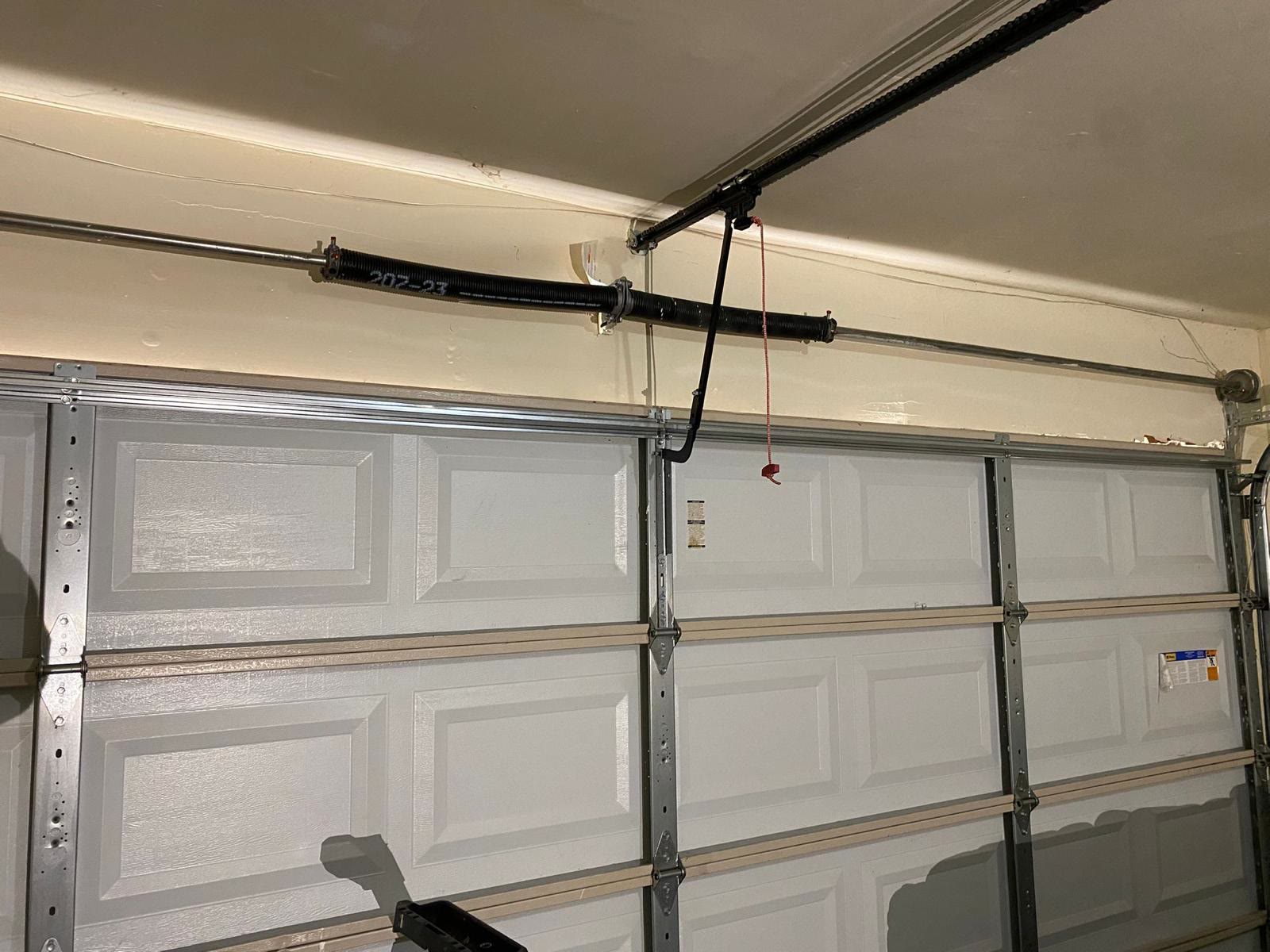
A third condition belongs with those two: a visible gap of an inch or two in a spring on the shaft above the door. That is a broken torsion spring. The door may still move a few inches and sound for all the world like an opener problem, and it is not one.
Stop conditions: a crooked door, a slack cable, or a gap in a spring
If the door sits crooked in the tracks, if a lift cable is slack or hanging, or if you can see a gap in the coil of a spring above the door, stop using the opener entirely and unplug it so nobody runs it out of habit. Do not force the door up or down by hand and do not put a shoulder under it. In all three conditions the counterbalance is gone or badly unbalanced, which means hundreds of pounds of door are restrained by hardware that is not in the load path it was designed for.
Need this done?
We handle garage door repair across Dallas and the eastern metroplex. Call (469) 891-6883 or book online.
Questions
Common questions
Why does my door only refuse to close in the late afternoon?
That pattern is nearly always low sun landing on the photo eye receiver and washing out the infrared beam, and it appears and disappears over a few weeks as the sun angle changes through the year. Confirm it by shading the receiver with your hand and trying again. A small hood over that sensor is a permanent fix.
Should I just turn the force setting up so the door stops reversing?
Not as a first move. Force protection is the system that stops the door on an obstruction, and raising it to cure a reversal removes the protection that was reporting a real problem. Run the hand test first: disconnect the opener and lift the door, and if it grabs or feels heavy anywhere, the reversal was correct and the door needs mechanical work.
How do I know whether the problem is the opener or the door?
Disconnect the opener with the release handle while the door is closed and lift by hand. A door that moves smoothly through its whole travel and holds position at waist height is mechanically fine, which points at settings, sensors, or electronics. A door that grabs, feels very heavy, or will not hold position has a counterbalance or track problem, and the opener is the victim rather than the cause.
My opener beeps and will not run even though the power is on. What is that?
On units with a battery backup, that is usually the backup battery reaching the end of its life and the unit reporting it. Garage heat through a Texas summer shortens those batteries noticeably. The battery is a replaceable part and the model number is on a label on the motor head.
The door closes only if I hold the wall button down. Is that safe to keep doing?
No, and it is a specific diagnosis rather than a workaround. Holding the button is a deliberate override that exists so a door can be closed when the photo eye circuit is not working, which means your safety sensors are faulty, miswired, or damaged. Have the sensor circuit repaired rather than living with the override, particularly with children or pets in the house.
More advice
Keep reading
Photo Eyes: Why the Door Reverses Before It Reaches the Floor
A door that starts down, touches nothing, and runs back up is almost always reporting a photo eye problem, and most of those take ten minutes and no parts. Here is how to read the LEDs, fix the ordinary causes, and recognize the faults that are not the eyes.
SafetyGarage Door Safety With Children and Pets
Both of the systems that stop a closing door fail quietly, and a door with a dead sensor looks exactly like a healthy one. Here are the two tests to run monthly, what a pass looks like, and where the real risk sits with kids and pets.
SpringsWhy Garage Door Springs Break, and What the Cycle Rating Actually Means
A garage door spring is spent in cycles, not years, and the arithmetic for your own household takes about a minute. This is how fatigue breaks spring steel, why the break happens with the door closed, and what a high cycle rating actually buys.